
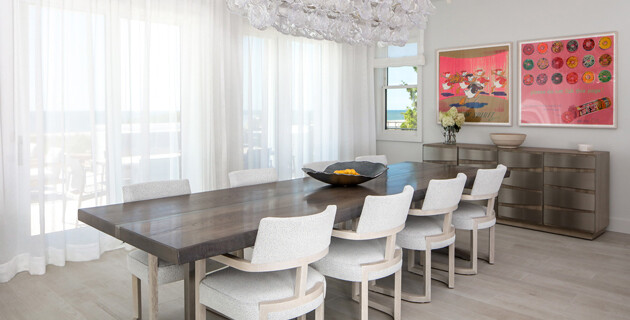
As I revisit the design of my living room, I find myself drawn to a shift in perspective that places art at the heart of the space. Rather than treating artwork as the final layer, I’m challenging myself to let one statement piece guide the room’s palette, mood, composition, and overall direction.
My design philosophy has always leaned toward fewer, larger décor elements rather than many small accents, but lately I’ve been craving even more clarity and refinement. Instead of starting over, I plan to work with what I already own, allowing the room to evolve through subtle styling changes and a more intentional palette.
To shape that vision, I’m looking at how top designers use art not simply as decoration, but as a visual anchor. From commanding canvases to color-driven abstraction and wallpaper that functions like a mural, these interiors show how art can influence the way a room feels, flows, and tells a story.
Pamela Harvey Interiors
As I began searching for inspiration, I found myself drawn to the work of Pamela Harvey Interiors, a studio that places art at the center of its design story. Her rooms are sophisticated yet approachable, always grounded by a sense of harmony between artwork and interior. Whether through a commanding canvas or a quieter work that adds depth and character, her spaces demonstrate how art can bring focus, feeling, and refinement to a room.
What feels especially inspiring in Pamela Harvey Interiors’ work is the way artwork becomes more than a decorative layer. It can serve as the emotional foundation of a room, guiding the palette, balance, scale, and overall sense of harmony so the surrounding design feels intentional, layered, and deeply connected.


Annette Jaffe Interiors
Some of the most compelling art doesn’t depict a subject at all. It evokes a feeling through color alone. In these striking interiors by Long Island-based Annette Jaffe Interiors, color gradation becomes the artwork, offering a quiet power that anchors the room with mood and meaning.
In one space, a trio of textured monochromatic canvases in deep, tonal blues draws the eye upward, echoing the vertical architecture and creating a sense of rhythm. In another, a large-scale ombré painting glows with sunset-inspired hues, transitioning from soft coral to dusky indigo.
What Annette makes so beautifully clear is that abstraction can influence a room far beyond the wall it occupies. Through subtle shifts in tone, color becomes a form of atmosphere, shaping how a space feels, flows, and quietly speaks to the people within it.


Betty Wasserman Art & Interiors
As I continue refining my vision, I’m also thinking about how the art and furnishings will live together in harmony, appearing as one cohesive statement. One designer I deeply admire, Betty Wasserman, captures this beautifully when she says, “When art and light are thought of as one, the outcome will not fail to impress.”
Her words are a reminder that art does not live on the wall alone. Its presence shifts with natural light, lamp placement, picture lighting, shadows, and the surrounding finishes. A piece that feels quiet in one setting can become luminous in another when light is treated as part of the design from the very beginning.
This is what makes Betty’s work so compelling: she understands that illumination is not simply functional, but emotional. Through thoughtful placement and atmosphere, her interiors reveal how the right light can bring depth, texture, and quiet drama to a piece, allowing the artwork to feel fully alive within the room.


Breathe Design Studio
As I explore the idea of designing around art, I’m also drawn to creative expressions that expand the definition of what art can be. Rather than opting for a traditional canvas, I’ve been drawn to the idea of using wallpaper as a statement—an accent wall that acts as artwork itself. With the right design, wallpaper can become the soul of a room, offering texture, movement, and emotion in a way that feels both fresh and timeless.
Interior designer Christine Ho of Austin's Breathe Design Studio beautifully illustrates this approach. Her use of bold, artistic wallpapers transform each space into a curated composition, where pattern, palette, and scale create an atmosphere that feels immersive and deeply personal.
Christine's work makes clear that wallpaper can do more than support a room’s design. It can become the element that gives the space its identity. When chosen with intention, it offers a visually compelling alternative to conventional artwork, turning the wall itself into a soulful and expressive focal point.


As I continue curating ideas and refining my vision, I’m inspired by the many ways art can lead the design process—through color, composition, texture, or scale. Whether it’s a commanding canvas, a tonal gradient, or a wallpaper that acts as a mural, I’m learning that when art takes the lead, the entire space begins to speak.
I’m excited to carry this inspiration into my own home and see how the space evolves with art leading the way.♥
